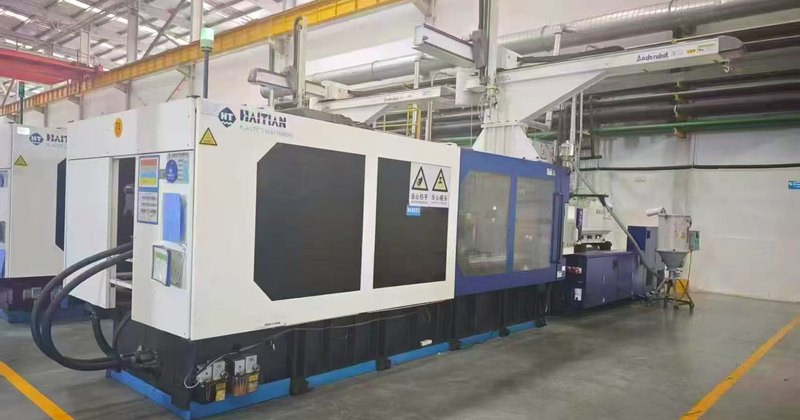
90T to 1600T from Haitian, Yizumi, Tederic and Chen Hsong. Every machine is checked electrically, hydraulically and mechanically, then run under load and recorded on video — so you are buying a machine you have seen working, not one you are taking on trust.
Stock changes constantly, so treat this as the range we work in rather than a live inventory list. Tell us the tonnage you need and we will tell you what is available at that moment, along with machine age and condition.
| Clamping force | Typical use | Common brands | Resin commonly run |
|---|---|---|---|
| 90 – 150 T | Small enclosures, caps, laboratory plastic parts | Haitian, Yizumi, Chen Hsong | PP, PE, ABS, PC |
| 200 – 320 T | Household products, thin-wall packaging, buckets | Haitian, Yizumi, Tederic | PP, PE, ABS, HIPS |
| 400 – 650 T | Crates, containers, appliance parts, pallets | Haitian, Yizumi, Tederic | PP, PE, ABS, PA |
| 800 – 1200 T | Automotive interior, large housings, industrial parts | Haitian, Yizumi, Chen Hsong | PP, ABS, PA, PC/ABS |
| 1400 – 1600 T | Large automotive, thick-wall parts, heavy duty | Haitian, Yizumi | PP, ABS, PA66, POM |
Sizes outside this range can often be sourced — including higher tonnages and imported machines. Send the requirement and we will confirm availability, age and price.
This is the part that matters when buying used. A machine can look clean and run badly. These are the checks we run, and they are what the written report records.
Power supply and wiring condition, main contactor and breaker health, control system faults logged and cleared, screen and operator panel function, encoder and sensor checks, servo drive function if fitted.
Oil condition and level, pump performance and pressure holding, valve set response, evidence of past leaks and whether they were properly repaired, accumulator condition, oil cooling function.
Tie bar condition, platen parallelism and alignment, screw and barrel wear relative to machine age and material, nozzle and heater bands, ejector and mould stroke, safety interlocks and guards.
The machine is actually run — not powered up and photographed — with a test mould or your tooling where available. Cycle time, injection weight and stability are recorded on video so you can judge the machine's real condition.
Machine model, serial number, year of manufacture, running hours if recorded, controller version, and what spare parts are included. You get the report and video before shipment, not after.
Machine secured for sea or road transport, oil handled per destination requirements, moving parts locked or removed and packed separately, moisture protection applied, spare parts and documents boxed separately.
Used machinery is a legitimate and often sensible purchase. But it carries specific risks, and any seller who does not mention them is telling you something. Here is the honest list.
Wear on the screw and barrel is measured, not guessed. Oil condition and service history are documented and dated. The controller model is confirmed before you commit, so you know whether parts will still be available in five years. Tonnage is matched to your part rather than to what is cheapest to ship. And every machine comes with the inspection report and running video before you pay the balance. Third-party inspection is welcome on request — we have no objection to you sending your own inspector.
| Factor | Used machine | New machine |
|---|---|---|
| Purchase cost | 30–55% of equivalent new price | Full price |
| Energy per part | Higher on older servo/hydraulic models | Lower, especially all-electric |
| Remaining service life | Uncertain — depends on condition, not hours | Full expected life |
| Spare parts availability | Risk on older control platforms | Full, for the model's production run |
| Lead time to production | Weeks | Longer, especially higher tonnage |
| Warranty | Limited — agreed per machine | Manufacturer warranty |
| Best when | Established product, stable tooling, budget-driven capacity add | New product launch, tight tolerance, energy costs dominate, no tolerance for downtime |
Our honest recommendation: if your product is already proven and your tooling is settled, a well-checked used machine is usually the better financial decision. If you are launching a new product, chasing tight tolerances, or cannot afford downtime, new is worth the premium. Send us the details and we will tell you which side of that line you are on.
Part, shot weight, resin, tonnage you need, budget, destination port. If you do not know the tonnage, send the part and we will calculate it.
We come back with available machines at that tonnage, with age, condition summary, photos and a full quotation. Usually within 4 hours on business days.
You get the condition inspection report and the running video for each machine. Third-party inspection available at this stage if you want it.
Payment terms agreed, machine reserved for you, export packing and loading, then documents and tracking sent. Technical support on arrival.
Send the part, resin and tonnage — or just what you are producing. We will come back with what is available, with the inspection report and running video for each.