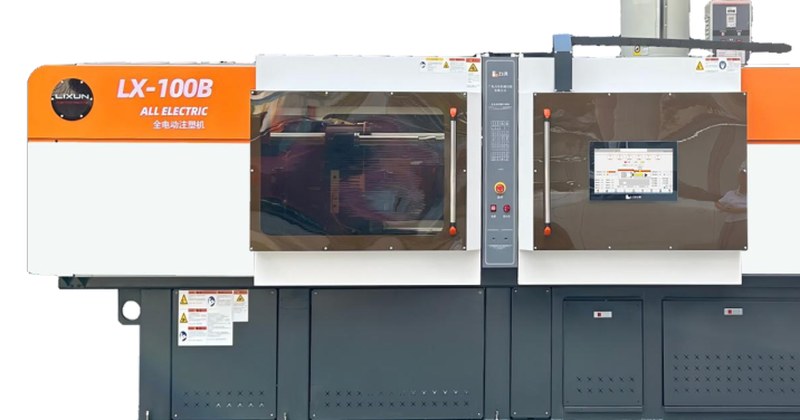
Servo-driven, no hydraulics, no oil to change. The LX series runs a repeatability of ±0.01 mm on a cycle fast enough for medical and optical parts, at roughly half to a fifth of the energy a hydraulic machine of the same size would draw.
An all-electric machine replaces every hydraulic function with a servo motor and screw drive. Nothing is gained by pretending that is right for every job — it is not. But where the part is precision-critical or the energy bill matters, the difference is large and measurable.
These are the sizes we most often supply. Not every tonnage in between is a standard configuration — if you need something outside this range, send the part and we will confirm what is available.
| Model | Clamping force | Typical shot weight (PS) | Screw diameter | Typical applications |
|---|---|---|---|---|
| LX5 | 50 kN | up to ~10 g | 14 mm | Micro-precision, medical, connectors, optics |
| LX25 | 250 kN | up to ~110 g | 22 mm | Laboratory devices, small housings, caps |
| LX50 | 500 kN | up to ~250 g | 28 mm | Optical parts, small containers, thin-wall packaging |
| LX90 | 900 kN | up to ~500 g | 32 mm | Medical components, precision fittings |
| LX130 | 1,300 kN | up to ~800 g | 36 mm | Technical parts, automotive interior, electronics housings |
| LX180 | 1,800 kN | up to ~1,200 g | 40 mm | Medical devices, appliances, optical assemblies |
| LX250 | 2,500 kN | up to ~1,800 g | 45 mm | Larger housings, industrial parts |
| LX320 | 3,200 kN | up to ~2,600 g | 50 mm | Automotive and larger structural parts |
| LX450 | 4,500 kN | up to ~4,000 g | 55 mm | Large automotive, pallets, heavy-duty packaging |
Note: shot weights are indicative and depend on the resin's specific gravity and the material's shrinkage allowance. Final configuration — screw L/D, plasticising capacity and injection unit size — is matched to your part when we quote. Clamp force is calculated, not guessed: we size against your part's projected area at the required filling pressure, with a safety factor, rather than selling the next size up.
The LX machines run CODESYS-based control over an EtherCAT fieldbus. In practice that means the machine follows your process settings rather than fighting them — which is what makes the repeatability figure hold up in production rather than on a spec sheet.
| Item | Specification |
|---|---|
| Control platform | CODESYS with EtherCAT fieldbus |
| Bus cycle time | Under 2 ms |
| Repeatability | ±0.01 mm (critical dimensions) |
| Drive type | Fully electric servo, no hydraulic circuit in the clamp or injection unit |
| Barrel zones | Multi-zone PID, individually controlled per zone |
Drawing, 3D file, or even photographs with dimensions written on them. Weight finished and the projected area of the part.
Resin grade, whether it is filled or unfilled, and whether you need virgin or recycled material. This changes both drying time and screw choice.
Annual quantity and how many shifts you intend to run. Cycle time targets are far more useful than total annual tonnage when we size a machine.
Port or city, and any voltage, standard or certification requirement in the destination country. We quote FOB or CIF as you prefer.
Machine size is calculated from your projected part area at the required filling pressure, with a safety factor applied — not rounded up to the next frame to make the number look better. Screw and plasticising unit are matched to your resin and shot weight. If a smaller machine will do the job, we will say so, because a correctly sized machine pays you back in cycle time and energy for years. Third-party inspection is available on request, and the quotation is valid for 30 days.
Tell us the drawing or weight, the resin and your annual volume. We will come back with a machine size and a price, usually within 4 hours on business days.